


Table of Contents
In recent years, Peer-to-Peer (P2P) lending has emerged as a disruptive force in India’s financial sector, offering both borrowers and investors an innovative alternative to conventional banking and financial services. Leveraging technology, P2P lending platforms create a direct connection between individuals seeking loans and those willing to lend money, bypassing traditional banking intermediaries.
In this article, lets explore the concept of P2P lending, its evolution and current landscape in India, as well as its opportunities, challenges, and future prospects.
What is P2P Lending?
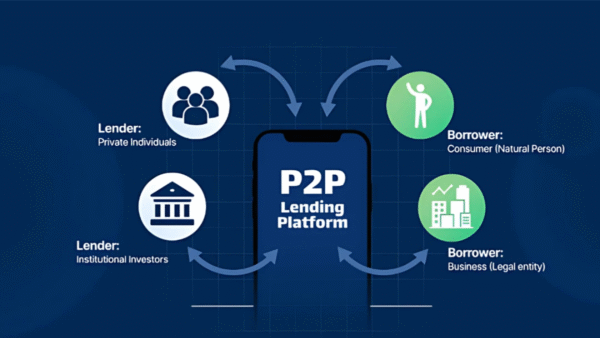
Peer-to-Peer lending, often abbreviated as P2P lending, is a form of debt financing where individuals can borrow and lend money directly to each other via online platforms. Unlike the legacy banking system—where banks assess, approve, and disburse loans using their own capital—P2P lending allows individuals to connect, negotiate terms, and complete transactions with minimal institutional involvement. The platform typically facilitates the entire process, from vetting borrowers to managing repayments, and charges a commission for its services. Borrowers apply for a loan online, and if approved, they get the money quickly. Then, they repay the loan in regular payments with interest over time.
How Does P2P Lending Work?
- Registration: Both borrowers and lenders sign up and create profiles on the P2P platform.
- Evaluation: Borrowers submit documents and undergo credit assessment by the platform, which may analyze income, credit score, employment details, and other factors to determine risk.
- Loan Listing: Approved borrowers post their loan requirements (amount, tenure, interest rate), and lenders browse these listings to select whom they want to lend to, based on risk preference and expected returns.
- Funding & Disbursement: A loan may be funded by one or multiple lenders. After the agreement, funds are transferred to the borrower, who begins repayment as per the mutually agreed schedule.
- Collections & Distribution: The platform manages EMI (Equated Monthly Installments) collection and distributes funds back to lenders.
The Rise of P2P Lending in India
India has witnessed rapid digitization of financial services. P2P lending emerged in response to gaps left by traditional institutions – high rejection rates for personal loans, insufficient credit access for small businesses, and limited investment options for individuals. With internet penetration and fintech innovation, P2P lending platforms have grown considerably.
Is there any Regulatory Framework for P2P Lending?
To address risks and ensure fair practices, the Reserve Bank of India (RBI) stepped in to regulate the sector. In 2017, the RBI classified P2P lending platforms as NBFC-P2P (Non-Banking Financial Company – Peer to Peer) and introduced guidelines requiring all platforms to obtain a license, adhere to strict norms, and ensure consumer protection.
Key RBI Regulations Include:
- Maximum lending and borrowing capped at ₹50 lakh per individual, aggregated across all platforms.
- Platforms can only act as intermediaries and cannot accept deposits or guarantee repayments.
- Risk profiling, data security, and transparent disclosure of all loan parameters.
- Minimum capital requirement for platforms (₹2 crore net owned fund).
- Mandated grievance redressal and regular reporting to RBI.
Leading P2P Platforms in India
India’s P2P lending sector features a host of platforms, each focusing on different borrower segments – from salaried professionals to micro-entrepreneurs.
Some notable platforms are Faircent, Lendbox, RupeeCircle, Finzy, LenDenClub, etc.
Benefits of P2P Lending
P2P lending presents several advantages for both borrowers and lenders:
For Borrowers
- Access to Credit: Quick and flexible access to funds, especially for those excluded by banks due to low income, informal employment, or a thin credit file.
- Competitive Rates: In many cases, interest rates may be lower than those offered by banks, depending on the borrower’s risk profile and negotiation.
- Simplified Process: Less paperwork and faster loan disbursement compared to bank procedures.
For Lenders
- Higher Returns: Returns can range from 12% to 30% per annum, often outperforming bank deposits or bonds.
- Diversification: Lenders can spread investments across multiple borrowers and risk profiles, reducing overall exposure.
- Democratic Investment: Lenders set terms, choose borrowers, and diversify their lending portfolios.
Risks and Challenges in P2P Lending
Despite its promise, P2P lending is not without risks:
Credit Default Risk
Borrowers may default on their repayments, causing potential losses for lenders. Platforms employ credit assessment algorithms and partner with credit bureaus but cannot eliminate this risk entirely. Unlike banks, there is no government guarantee for lenders.
Platform Risk
Reliance on the integrity and efficiency of the P2P platform poses risks. Operational or financial failure of a platform could hamper lender recoveries.
Regulatory Risk
As an emerging sector, future policy changes by the RBI or the government may reshape the landscape, affecting profitability or compliance requirements.
Information Asymmetry
Accurate credit assessment is challenging, and platforms may not always capture a borrower’s true financial position.
The Investor Perspective
For individuals seeking higher yields, P2P lending allows direct participation in India’s expanding credit markets. The ability to customize lending strategies—choosing borrowers, tenures, and amounts—appeals to those keen on building diversified portfolios.
P2P platforms also enable micro-investments, with minimum amounts as low as ₹500 per loan. Some platforms use automated algorithms to allocate investments based on risk criteria, further simplifying the process for busy investors.
However, prudent investors should carefully analyze borrower profiles, understand platform terms, and avoid putting substantial sums into single loans or platforms.
Social and Economic Impact
P2P lending is helping democratize access to credit across India. Small businesses, freelancers, and those with informal incomes often find traditional banking doors closed. P2P platforms bridge this gap, fostering entrepreneurship, consumption, and social mobility.
There is also evidence that P2P lending supports financial inclusion, as lenders are willing to finance causes—such as education loans or medical emergencies—that may not appeal to risk-averse banks.
Conclusion
P2P lending in India has brought a paradigm shift to the ways individuals and businesses access loans and investment opportunities. Under the careful watch of the RBI, the sector is poised for further expansion, balancing innovation with risk management. For investors, it is a chance to earn superior returns while supporting financial inclusion. For borrowers, it is an accessible, transparent, and timely gateway to funds.
Disclaimer: The information provided in this article is for general informational and educational purposes only. It does not constitute financial advice, investment recommendations, or an offer to buy or sell any securities or financial products. Readers are advised to conduct their own research and seek advice from a qualified financial advisor before making any investment decisions.