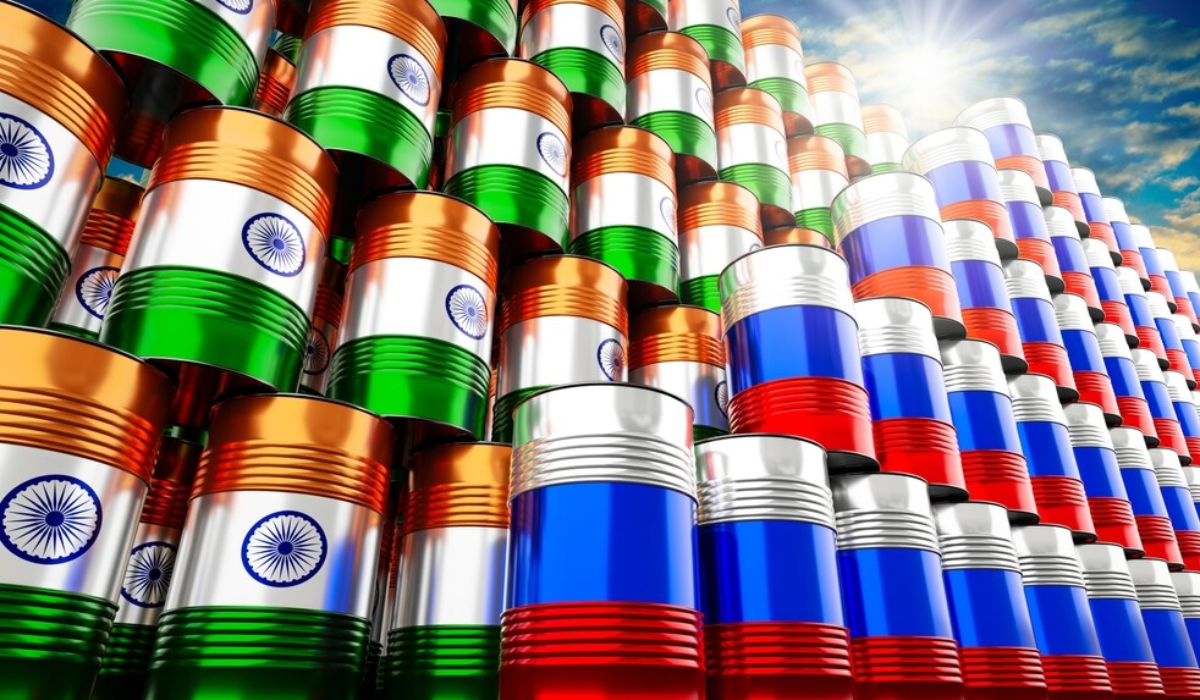
| New Delhi – India’s crude oil imports from Russia have seen a significant surge in the first half of October 2025, reversing a declining trend that persisted from July through September. This increase is primarily driven by Indian refineries running at full capacity to accommodate a spike in demand due to the country’s ongoing festive season. Imports of crude oil from Russia to India fell from over 2 million barrels per day in June 2025 to 1.6 million barrels per day in September 2025. This sharp reduction reflects a notable drop before the recent rebound seen in early October. These figures are based on tracking data and industry reports, providing clear evidence of the import decline during this period. Tanker-tracking data for early October 2025 indicate that shipments of Urals and other Russian crude grades to India have rebounded significantly. This increase has been facilitated by renewed discounts from Russian suppliers, which became possible due to weakened demand in Western markets. Preliminary data from global trade analytics firm Kpler indicate that India’s imports of Russian crude in October 2025 are tracking at approximately 1.8 million barrels per day (bpd). This represents an increase of about 250,000 bpd compared to September’s figure of around 1.55 to 1.6 million bpd, showing a marked rebound after the decline in previous months. The data for the current month are provisional and subject to revision as final shipping and customs statistics become available. The import data cited—from sources like Kpler—reflect India’s Russian crude purchases during the period preceding US President Donald Trump’s statement on October 15, 2025, where he claimed Prime Minister Narendra Modi had agreed to halt Russian oil imports. Ministry of External Affairs spokesperson Randhir Jaiswal stated that he was not aware of any phone conversation between President Donald Trump and Prime Minister Narendra Modi regarding an agreement to stop Russian crude imports. This suggests that, as of now, there is no official confirmation from the Indian government about such a discussion or agreement taking place. Sumit Ritolia, Lead Research Analyst (Refining & Modelling) at Kpler, assessed that President Trump’s statement was likely a form of pressure tactics related to ongoing trade negotiations, rather than an indication of any immediate or imminent policy shift by India regarding Russian crude imports. According to Ritolia, current data and official responses suggest no change in India’s import policy as a direct result of Trump’s comments. “Russian barrels remain deeply embedded in India’s energy system for economic, contractual, and strategic reasons,” he said. Indian refiners have confirmed that they have not received any instructions from the government to halt imports of Russian oil. India began purchasing discounted Russian oil after Western nations imposed sanctions on Moscow and shunned its supplies following Russia’s invasion of Ukraine in February 2022. As a result, Russia’s share of India’s total oil imports surged—from a minor 1.7% in 2019–2020 to as much as 37–40% by 2024, making Russia India’s largest crude supplier. Indian refiners were drawn to Russian oil due to the attractive price discounts offered, which helped India reduce energy costs amidst global volatility and shifting geopolitics. After Russia, Iraq was the second largest crude oil supplier to India, providing approximately 1.01 million barrels per day (bpd). Saudi Arabia followed as the third-largest supplier with about 830,000 bpd. The United States, having overtaken the UAE, became India’s fourth-largest supplier at 647,000 bpd, while the UAE supplied 394,000 bpd according to Kpler’s data. Sumit Ritolia of Kpler emphasized that Russian crude oil continues to be structurally vital for India, currently making up about 34% of the nation’s total crude imports. He noted that the discounts offered on Russian grades are compelling and too substantial for Indian refiners to overlook, supporting both competitiveness and cost-effectiveness for the sector. This underscores the enduring importance of Russian oil in India’s energy mix despite external pressures. There has been a lot of talk about the dip in imports during July-September. “This was driven less by tariff concerns and more by seasonal factors, particularly increased maintenance activity at PSU refineries such as MRPL, CPCL, and BORL,” he said. Most contracts for Russian crude deliveries to India scheduled through early September 2025 were finalized 6–10 weeks ahead of delivery, which means that the majority of these deals were locked in before July 31. So dips in July-September were mostly due to refinery processing less crude in view of maintenance schedules. Even with narrower discounts than in 2023, Russian barrels remain one of the most economical feedstock options available to Indian refiners, due to landed discounts and high GPW (Gross Product Worth) margin outputs from grades such as Urals. Discounts average between $3.5-5 per barrel, up from $1.5-2 in July/August. Replacing Russian crude is not difficult, as more barrels could flow from the Middle East, Latin America, and the US, similar to India’s pre-2022 crude slate. Indian refineries can handle diverse crude grades, so the technical constraint is minimal. But whether New Delhi is ready to make that shift is another matter, he said. “The reality is that cutting Russian imports would be difficult, costly, and risky.” Substitution would require rapid scaling from multiple suppliers, at higher costs (freight, weaker discounts). If margins compress or retail prices rise, the result could be inflation, political backlash, and weaker refinery profitability. He believes refiners won’t leave a dollar on the table unless directed by the government – just as happened with Iranian barrels. While there has been a stronger push for diversification, contracts for Russian crudes are typically signed 6–10 weeks before arrival. India has consistently pursued an independent foreign and energy policy, balancing economic interests with diplomatic relationships. A sudden shift away from Russian crude would jeopardize India’s energy security strategy, making such a move improbable unless formal, far-reaching sanctions—comparable to those imposed on Iran or Venezuela—are enacted against Russian oil. Indian refiners’ dependence on Russian barrels for both pricing and supply stability means that only strict international sanctions would compel a rapid withdrawal; otherwise, Russian crude remains critical to India’s energy mix. “At this stage, it’s improbable that India will implement structural cuts purely to satisfy US and EU political pressure. “If Washington intensifies pressure, Indian refiners could make a token reduction – on the order of 100,000-200,000 bpd – to demonstrate diversification and appease Western partners. “However, these cuts would likely be symbolic rather than transformative,” he added. Importing higher volumes from the US to placate Trump is an option, but the upside is capped at around 400,000-500,000 bpd. This is because US grades face both logistical disadvantages, economic and compatibility challenges with Indian refining systems. According to Kpler data, Indian imports of US crude oil have averaged 310,000 barrels per day (bpd) so far in 2025, up from an average of 199,000 bpd in 2024. In 2025, imports from the US reached a yearly high of approximately 500,000 bpd, highlighting an increasing trend in India’s crude purchases from the United States. This growth demonstrates India’s efforts to diversify its crude oil supply sources beyond Russia and the Middle East. |