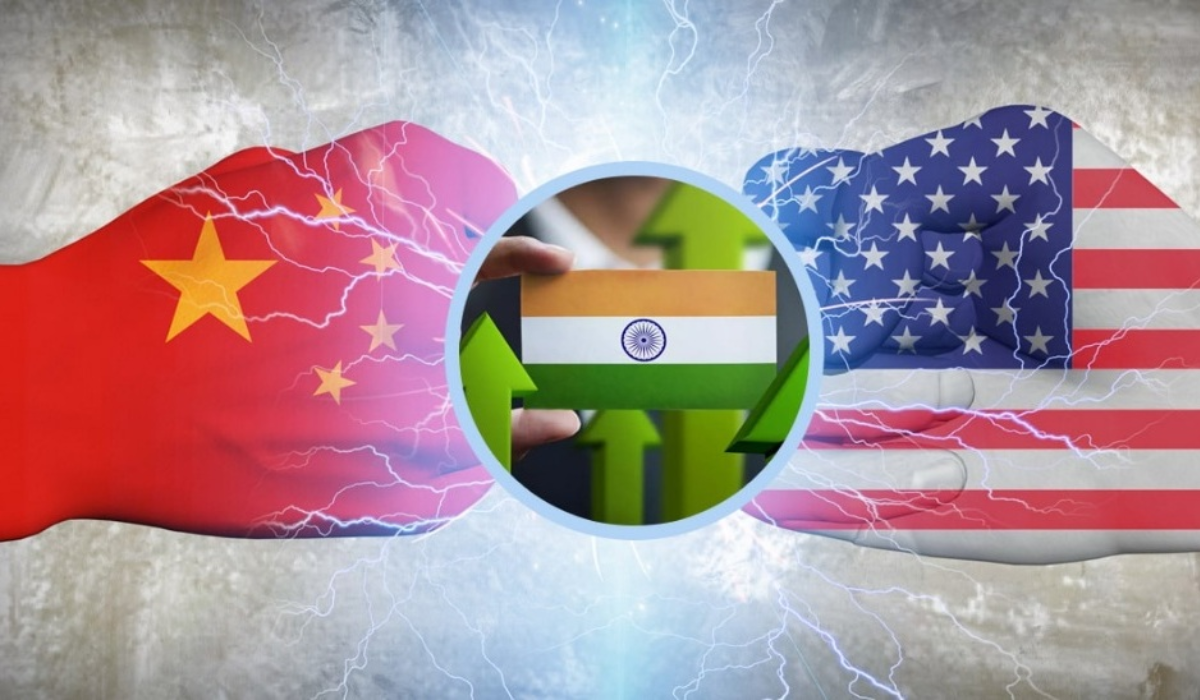
| New Delhi – The trade conflict between United State and China is likely to benefit Indian exporter, as additional tariff on Chinese goods make US to look for alternative supplier. Federation of Indian Export Organisations (PTI) President S.C. Ralhan highlighted the potential for increased demand for Indian products in the American market. “We may gain from this escalation,” PTI quoted him as saying. Analysts note that with Chinese goods becoming costlier due to the U.S.’s new tariffs, Indian exporters could gain market share in categories where price competitiveness is critical. The new tariffs would push up prices of Chinese goods in the American market, making them less competitive. “Now this 100 per cent additional tariff on Chinese goods will give us an upper edge,” a textile exporter told PTI, adding that the higher customs duties provide “huge export opportunities for India to America.” The US has announced an additional 100 per cent tariff on Chinese goods starting November 1, 2025, raising the overall tariff rate on Chinese imports to about 130 per cent. With U.S. tariffs on Indian goods currently at 50%, higher than China’s 30%, Indian exporters are positioned to leverage the cost advantage in high-volume, price-sensitive segments. Experts say that while the immediate opportunity is clear, sustaining gains will require exporters to scale capacity, ensure quality standards, and align with U.S. compliance requirements. The U.S. remained India’s largest trading partner in 2024-25, with bilateral trade valued at USD 131.84 billion, including USD 86.5 billion in Indian exports. The U.S. accounts for around 18% of India’s total goods exports and 10.73% of the country’s total merchandise trade. India and the U.S. are negotiating a bilateral trade agreement, which could further consolidate India’s position as a preferred alternative to China. The Trump’s additional 100% tariff move came after China imposed sweeping new controls on rare earth exports on October 9, 2025, materials critical for U.S. defense, electric vehicles, and clean-energy industries. Trump also questioned a planned meeting with Chinese President Xi Jinping in South Korea, saying on social media, “now there seems to be no reason to do so,” though he later clarified, “I haven’t canceled. I would assume we might have it.” |